That question frames a common practical choice for U.S.-based crypto traders who want speed, custody options, and clear operational controls. OKX presents itself as an all-in-one exchange and Web3 platform: centralized order books and derivatives, a non-custodial wallet, staking and DeFi access, an NFT marketplace, and a DEX aggregator. But those features interact in ways that matter for real decisions—how you log in, whether and when to verify identity, how spot execution behaves under stress, and when to move assets into self-custody. The mechanics determine outcomes more than the marketing line.
In this case-led analysis I follow a representative scenario: a U.S. retail trader who wants to log in, complete KYC, use the OKX Web platform to place spot trades, and decide between leaving capital on OKX for staking and yield or moving assets into a non-custodial wallet. I will explain the underlying mechanisms, the trade-offs, concrete limitations, and practical heuristics you can reuse.
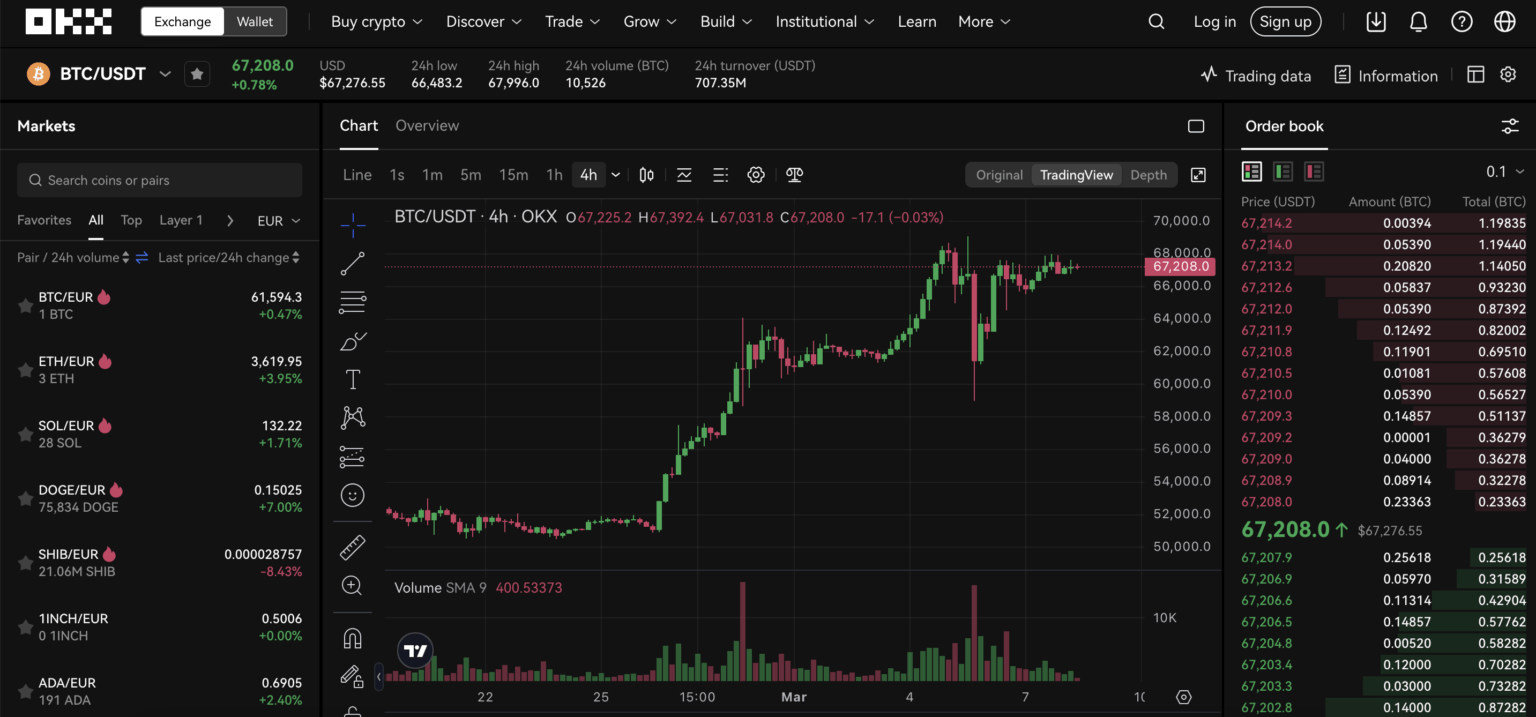
How OKX login and account protection actually work
The first mechanical layer is authentication and session control. OKX uses mandatory Two-Factor Authentication (2FA) plus AI-driven monitoring to flag anomalous logins. In practice that means: after your password you must use either SMS, Google Authenticator, or biometric options on mobile. Session risk detection can prompt additional checks or temporarily block actions when a login looks suspicious (new device, unusual IP, or rapid repeated attempts).
For U.S. users the practical consequence is a slightly higher friction at login that buys you a lower surface area for credential theft. A second, important distinction: OKX supports both custodial (exchange-held) accounts and a non-custodial Web3 wallet. Custodial accounts benefit from centralized safeguards like cold-storage multi-signature withdrawals (OKX keeps over 95% of assets offline), but the trade-off is that recovery and access are mediated by the platform—if you lose account credentials and fail KYC, regaining control can be slow or impossible. Non-custodial wallets transfer responsibility: you control the seed phrase, and losing it typically means permanent loss of access.
If you need the direct login page, use the exchange’s authenticated entry point for the best protection and avoid phishing: okx login. This matters because phishing remains the single most common first step in account takeovers; always confirm the URL, use bookmarks, and enable hardware-backed MFA where possible.
Identity verification (KYC): mechanism, constraints, and US implications
OKX enforces Know Your Customer (KYC) checks to comply with AML rules. Mechanically, this involves submitting a government-issued ID and completing a facial liveness check. For U.S. users this means the process is generally straightforward but not optional if you want full account features: fiat on-ramps, higher withdrawal limits, derivatives, and certain regional services often require completed KYC.
Important limits and trade-offs: KYC increases regulatory safety and enables services, but it also creates a central point of privacy loss—the exchange holds identifying data. If your priority is privacy, non-custodial wallets and on-chain interactions are better in principle, but they sacrifice the convenience of fiat rails and platform-level insurance. From a risk-management perspective, a hybrid approach is common: complete KYC for your exchange account to access rails, but keep only working capital on the exchange and use the Web3 wallet or hardware wallets for long-term holdings.
Spot trading mechanics and what delisting means for traders
Spot trading on OKX uses a centralized limit order book and market/limit order types, complemented by TradingView-integrated charting for technical work. Execution characteristics you should understand: order routing is internal (CEX), liquidity depends on active order depth, and slippage can spike on low-volume pairs or during fast moves.
Recently OKX announced routine delistings of several spot pairs (RSS3, MemeFi, GHST, RIO, SWEAT). Delisting is mechanistically simple—pairs with low volumes, thin liquidity, or regulatory concerns are removed to protect wider clients from stale markets and errant price discovery. For traders this matters practically: if you hold a delisted token on OKX it may be converted, withdrawn, or restricted; you should plan exits before delisting windows close. The policy is not unusual among exchanges, but it is a reminder that asset availability is a moving target and not guaranteed indefinitely.
Custody choices: on-exchange, cold storage, and non-custodial wallet mechanics
Understanding custody mechanics clarifies most security and operational trade-offs. OKX’s custodial model stores the majority of funds in air-gapped cold wallets using multi-signature withdrawal approvals—this reduces the risk of a single-authority theft. The trade-off is counterparty: you trust OKX’s operational controls and legal processes. Proof of Reserves (PoR) adds transparency by enabling on-chain verification that user deposits are backed, but PoR does not substitute for legal guarantees or insurance on custodial balances.
Non-custodial Web3 wallets give you sole control of private keys and seed phrases, and OKX supports hardware integrations like Ledger and Trezor. Mechanically, interactions with DApps or yields require users to approve smart contract calls—this is where smart-contract risk and phishing can lead to loss. A useful heuristic: keep only what you actively trade on the exchange, and custody long-term capital in hardware wallets with a tested recovery plan.
Staking, yield farming, and the liquidity trade-off
OKX offers flexible staking, fixed-term lock-up staking, and DeFi yield farming with features like auto-compounding. The mechanism is simple: by staking, you either delegate assets to validators (PoS) or lock tokens for protocol incentives. Rewards compound but sometimes require lock-up periods that reduce liquidity. The decision trade-off is immediate yield versus on-demand access. If you need expeditionary liquidity for active spot trading, keep a cash buffer; if you are optimizing for yield, lock-up products can increase returns at the cost of flexibility.
DeFi yield farming through the Web3 wallet or DEX aggregator taps liquidity across chains. Aggregators find routes to reduce slippage, but they expose users to smart-contract risk and cross-chain bridge vulnerabilities—mechanical hazards that remain significant despite improvements in audits and insurance products. Always weigh yield percentages against quantified risks: higher APYs often reflect greater protocol risk or market illiquidity.
When spot trading breaks: volatility, slippage, and liquidity black swans
Spot markets are straightforward until they aren’t. The mechanics behind a “broken” trade are: low order book depth + sudden large market orders = wide slippage and execution at worse-than-expected prices. During extreme volatility, market orders can cascade, and exchanges may pause trading or widen spreads to protect integrity. OKX has market risk controls (circuit breakers, margin calls for margin users), but these are not foolproof. For U.S. traders the practical rule is to use limit orders for entry/exit and predefine acceptable slippage—market orders are simpler but can incur substantial cost in crises.
Another boundary condition: delistings and regulatory changes can limit exit routes for obscure tokens. Holding tokens on an exchange assumes the exchange will continue to support withdrawals; history shows that this is not an absolute guarantee. The safer posture is diversified custody and pre-planned exit strategies for lower-liquidity positions.
Decision-useful frameworks and a short checklist
Here are reusable heuristics for the scenario (login → KYC → spot trade → custody decision):
– Decide your role: active trader (short time horizon) vs. investor (long horizon). Keep only active capital on-exchange. – Harden login: use hardware MFA or authenticator app, enable AI-triggered session alerts if available, and bookmark the login URL. – Complete KYC if you need fiat rails or higher limits, but minimize personally identifiable data exposure elsewhere. – Use limit orders and pre-defined slippage tolerance on spot trades; avoid market orders on thin pairs. – Allocate staking vs. liquidity according to need for access: higher yield typically equals lower short-term liquidity. – Move long-term holdings to a hardware-enabled non-custodial wallet and test recovery procedures.
These steps are simple but directly map to mechanical risks: authentication, custody, execution, and liquidity.
FAQ
Do I need to complete KYC to trade spot on OKX in the U.S.?
Basic account creation allows limited access, but completing KYC is generally required for full spot trading features, higher withdrawal limits, fiat on/off ramps, and derivatives access. KYC is a legal compliance measure; its absence limits service availability rather than improving privacy.
Is my money safer in OKX cold storage than in my own hardware wallet?
They are different kinds of safety. OKX cold storage with multi-signature control reduces platform-wide hacking risk and operational theft, but it introduces counterparty and legal reliance on the exchange. A hardware wallet gives you sole control but no recourse if you lose the seed phrase. The right choice depends on your threat model: platform risk vs. self-custody risk.
How does OKX’s DEX aggregator reduce slippage?
The aggregator searches multiple liquidity pools across DEXs and chains to find an optimal route for a swap, splitting orders if necessary. This reduces effective slippage compared to single-pool trades, but it cannot eliminate market impact on very large orders or protect against cross-chain bridge failures.
What happens if a token I hold on OKX is delisted?
Delisting procedures vary but typically involve an announcement window, after which trading is disabled and withdrawals may be allowed for some period. If you hold a delisted asset, monitor exchange notices and withdraw before deadlines where possible. Delisting is a liquidity and availability risk that can restrict your options.
Final takeaway: OKX combines institutional-style custody, advanced trading tools, and Web3 access in one platform, but each capability brings a distinct mechanism and trade-off. For U.S. traders, prioritize hardened login procedures, complete KYC if you need rails and limits, use limit orders and slippage controls for spot trading, and adopt a custody split that aligns active capital with exchange convenience and long-term capital with hardware-backed self-custody. Watch for operational signals—delistings, unusual withdrawal limits, or repeated login anomalies—as early warnings that should change how much you keep on-platform.

0 Comments